Prostate Cancer
Single-Port Robotic Radical Prostatectomy
A complete guide to single-port robotic prostatectomy — how the surgery works, what recovery genuinely looks like, and the questions patients ask most.
If you’ve recently been diagnosed with prostate cancer, you’re probably reading more medical information than you ever expected to. This page walks you through how I perform robotic prostatectomy, what the recovery genuinely looks like, and the questions my patients ask most. My goal is that you finish reading with a clear picture of what surgery would mean for you — whether or not you ultimately choose it.
What is a radical prostatectomy?
A radical prostatectomy is surgery to remove the entire prostate gland and the seminal vesicles attached to it. The urinary tract is then reconstructed by sewing the bladder directly to the urethra, so you urinate the same way you did before — just without a prostate.
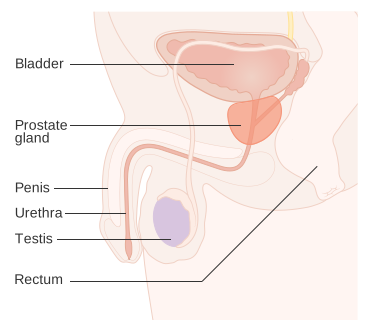
The prostate sits directly below the bladder and surrounds the urethra. Illustration: Cancer Research UK, CC BY-SA 4.0

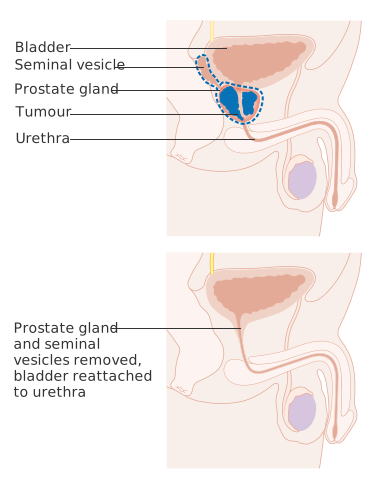
Before and after: the prostate and seminal vesicles are removed, and the bladder is sewn directly to the urethra. Illustration: Cancer Research UK, CC BY-SA 4.0

Why choose surgery?
Prostate cancer can be managed several ways — active surveillance, radiation, and surgery all have a role, and I discuss all of them with every patient. Surgery offers some specific advantages worth understanding:
- You get the complete answer. Removing the prostate gives us a full pathology report — the exact grade, extent, and margins of your cancer. No other treatment provides this information.
- PSA becomes a clear signal. After the prostate is removed, your PSA should fall to undetectable. That makes follow-up simple and unambiguous: if PSA stays at zero, you’re clear.
- Radiation stays in reserve. If cancer were ever to recur after surgery, radiation remains a highly effective backup. Doing it in the other order — surgery after radiation — is far more difficult.
- Hormone therapy is often avoided. Many patients who choose radiation also need months of hormone therapy. Surgery alone frequently spares you that.
The right choice depends on your cancer’s risk profile, your health, and your priorities. When you come in for a consultation, we’ll go through your specific situation — and if surgery isn’t your best option, I’ll tell you that.
The single-port difference
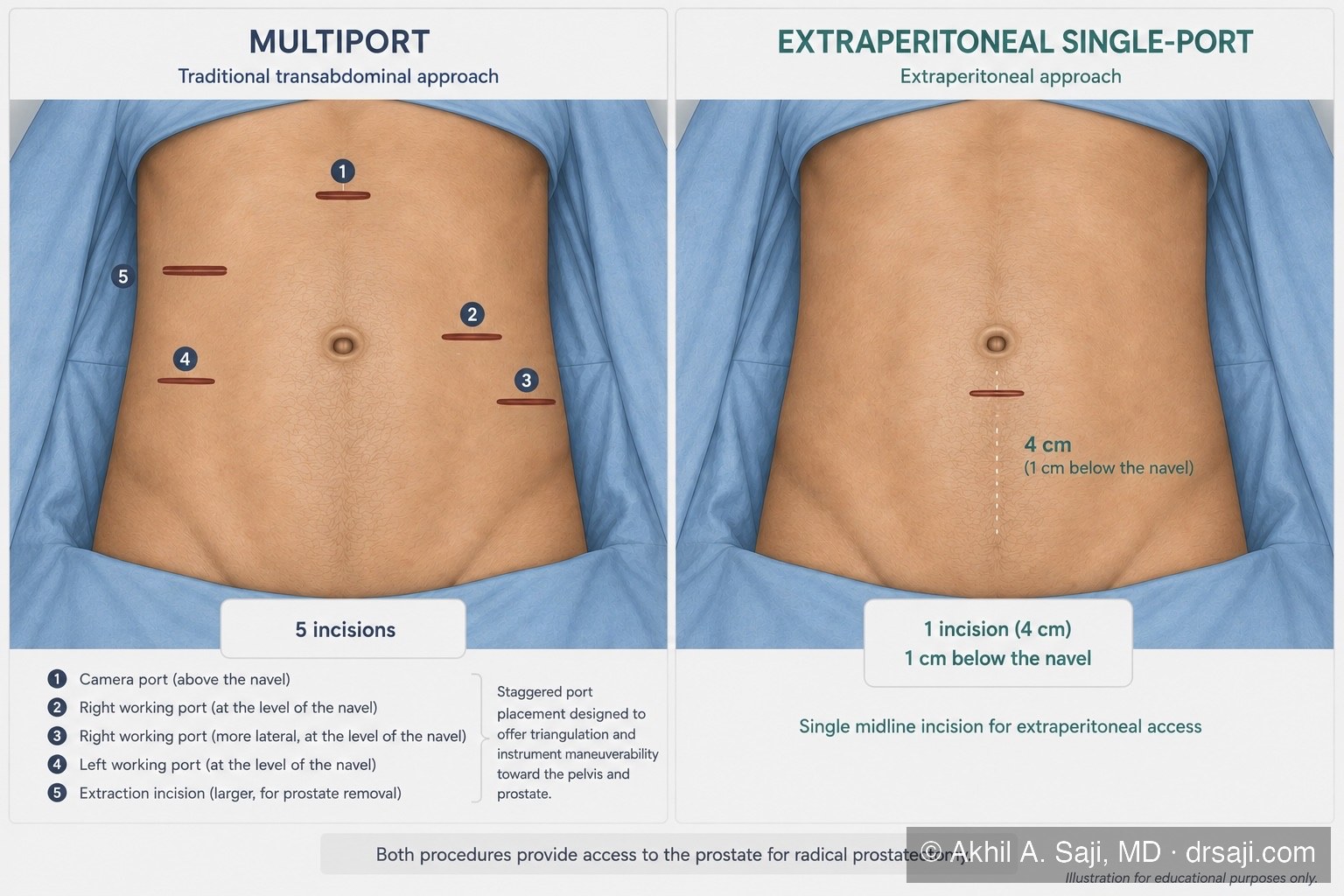
I perform essentially all of my prostatectomies with the da Vinci SP (single-port) robotic system, through one small incision about 1 cm below the navel. Most robotic prostatectomies in the United States are still done with five or six separate incisions across the abdomen; single-port surgery accomplishes the same operation through a single one.
I trained in single-port surgery with Dr. Mutahar Ahmed at Hackensack University Medical Center, one of the pioneers of the technique, and in robotic surgery with Dr. Inderbir Gill at USC, one of the surgeons who built the field. Robotic prostatectomy is the core of my practice.
In my experience, the single-port approach means:
- Less pain. One small incision instead of several, combined with low-pressure techniques during surgery, translates to noticeably easier recoveries. Most of my patients need little or no opioid pain medication.
- Faster return to normal life. Patients are walking the same day and back to desk work in about a week.
- A nearly invisible scar. The incision sits about 1 cm below the navel and is hard to find once healed.
To be clear: the robot doesn’t operate on you — I do. The robotic system is an instrument I control completely, giving me magnified 3D vision and instruments that move with more precision than the human wrist. Every movement is mine.
Nerve-sparing: how I plan your operation
The nerves responsible for erections run along both sides of the prostate in structures called the neurovascular bundles. Preserving them matters enormously for your recovery of sexual function — but nerve-sparing is not all-or-nothing, and it isn’t right for every cancer.
Before your surgery, I study your MRI and your biopsy map to plan exactly how much nerve tissue can be safely preserved on each side — full, partial, or none — based on where your cancer sits. I will tell you before surgery what degree of nerve-sparing I expect in your specific case, so you go in with honest expectations rather than hopeful guesses.
One principle guides every one of these decisions: curing your cancer comes first. If preserving a nerve bundle would risk leaving cancer behind, the cancer wins that argument.
In some patients, I also remove pelvic lymph nodes during the same operation. This is a staging step — it tells us whether cancer has spread beyond the prostate — and I recommend it when your cancer’s risk profile warrants the information.
Your hospital stay
Most patients spend one night in the hospital and go home the next morning. Select patients — generally healthy, motivated, with good support at home — can go home the same day.
You’ll wake up with a urinary catheter, a soft tube that drains the bladder while the new connection between your bladder and urethra heals. You’ll be up and walking within hours of surgery.
Living with the catheter
The catheter stays in for 7 to 10 days, depending on you and your anatomy. I know it’s the part patients dread most, but nearly everyone tells me afterward it was easier than they feared. You’ll go home with simple supplies and instructions, and you can move around, shower, and live fairly normally with it.
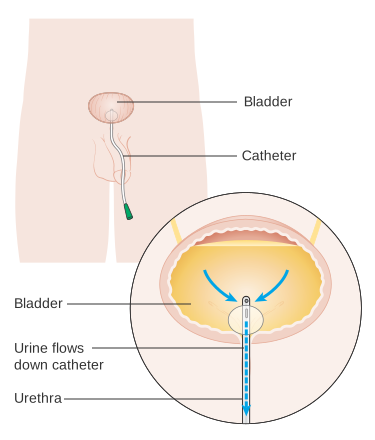
The catheter drains the bladder while the new connection to the urethra heals. Illustration: Cancer Research UK, CC BY-SA 4.0

When it’s time, the catheter is removed during a quick office visit — no special imaging needed, and removal takes seconds.
Recovery timeline
| When | What to expect |
|---|---|
| Day of surgery | Walking the halls; most patients need minimal pain medication |
| First week | Home, catheter in place; light activity, short walks, no lifting |
| ~Day 7 | Catheter removed in the office |
| Week 1–2 | Back to desk work; driving once the catheter is out and you’re off pain medication |
| Weeks 4–6 | Return to full activity, exercise, and lifting |
Every patient’s pace differs somewhat, and I’ll adjust this guidance to you at your follow-up visits.
Urinary control after surgery
Expect some urinary leakage after the catheter comes out — this is normal, temporary, and not a sign anything went wrong. The prostate sits between the bladder and the urinary sphincter, and removing it asks the sphincter to take on work it shared before. It needs time to strengthen.
Most of my patients regain urinary control over the first three months, often sooner, with continued improvement through the first year. Pelvic floor exercises help speed this along.
Sexual function after surgery
I’d rather be honest with you here than optimistic in a way that sets you up for disappointment. Recovery of erections after prostatectomy is real but gradual, and it depends on three things: your age, your erectile function before surgery, and the degree of nerve-sparing your cancer allowed. Nerves recover slowly — improvement continues over six months to two years.
Every patient of mine starts an individualized rehabilitation plan early in recovery, designed to protect the erectile tissue and support the nerves as they heal. And if recovery falls short of what pills can support, effective options exist at every step — no one is left without a path forward. This is a conversation we’ll have openly, before and after surgery.
Risks, honestly
Every operation carries risk, and you deserve a straight account of it rather than fine print.
Expected and temporary: urinary leakage in the early weeks; changes in erections that recover gradually; fatigue for a few weeks.
Uncommon: bleeding requiring transfusion, infection, hernia at the incision, fluid collections when lymph nodes are removed.
Rare: injury to the rectum or surrounding structures, problems with the bladder-urethra connection, or the need to convert to a different surgical approach.
Permanent changes to know about: after prostatectomy you will no longer ejaculate fluid (orgasm itself is still possible), and you cannot father children naturally. We’ll discuss anything on this list that concerns you at your consultation, in as much detail as you want.
Follow-up after surgery
Your pathology report is ready about a week after surgery, and we review it together. After that, follow-up is built around a simple blood test: PSA, starting about three months after surgery and continuing at regular intervals for years. After successful prostatectomy, PSA should be undetectable — and as long as it stays there, you need nothing more than that blood draw.
Frequently asked questions
Is the robot actually doing the surgery? No. I perform every step of the operation, seated at a console a few feet from you, controlling the instruments directly. The robot has no autonomy — it’s a precision instrument, like a surgeon’s hands with steadier wrists and better eyesight.
Is single-port surgery proven? It sounds new. The single-port platform received FDA approval in 2018 and has been used in tens of thousands of urologic operations since. The operation itself — robotic radical prostatectomy — is the same proven procedure performed hundreds of thousands of times worldwide; the single port changes how we access the prostate, not what we do once there. I trained with one of the surgeons who pioneered the approach.
Why surgery instead of CyberKnife or proton therapy? Those are forms of radiation, and radiation is a legitimate option for many men. The differences that matter: surgery gives you a complete pathology report, an unambiguous PSA marker afterward, and keeps radiation in reserve as a backup. Radiation after surgery works well; surgery after radiation is much harder. We’ll discuss whether that trade-off favors surgery in your case.
How long does the operation take? Plan on a few hours in the operating room, with additional time before and after. Your family will be updated when I’m done.
When can I shower? Drive? Fly? Shower: within a day or two, even with the catheter. Drive: once the catheter is out and you’re off pain medication — usually a bit over a week. Fly: short flights are reasonable within a couple of weeks; we’ll talk through longer travel plans individually.
When can I go back to work? Desk work, about a week — many patients work from home with the catheter still in. Physically demanding jobs, closer to four to six weeks.
What’s it like managing the catheter at home? Easier than you fear. It drains into a bag, you’ll get a smaller leg bag for moving around, and we send you home knowing exactly how to handle it. My office is a phone call away the entire week.
Considering this procedure?
I see patients at Swedish in Seattle and care for patients across Washington and the Pacific Northwest. Call to schedule a consultation.
Call (206) 386-6266