Enlarged Prostate (BPH)
Single-Port Robotic Simple Prostatectomy (Transvesical)
A complete guide to single-port transvesical simple prostatectomy for very large prostates — how the operation works, why the approach matters, and what recovery genuinely looks like.
If your prostate has grown large enough that medications no longer help — or you’ve been told your gland is “too big” for the standard procedures — this page is for you. A simple prostatectomy removes the obstructing inner portion of the prostate and is the most definitive treatment we have for very large glands. I perform it robotically through a single small incision, going directly through the bladder without entering the abdominal cavity. Here I’ll explain exactly how it works, what recovery looks like, and how it compares to your other options.
First, what “simple” means — and what it doesn’t
The name is misleading: a simple prostatectomy is not a smaller version of cancer surgery. It’s a different operation for a different problem.
In prostate cancer surgery (radical prostatectomy), the entire prostate is removed. In a simple prostatectomy for BPH, I remove only the enlarged inner core of the gland — the adenoma — and leave the outer shell (the capsule) in place. The classic analogy is an orange: BPH grows in the fruit, and I remove the fruit while leaving the peel. Because the outer capsule and everything around it stays untouched, the operation behaves very differently from cancer surgery — recovery of urinary control is the rule, and erections are not put at the same risk.
Why a large prostate blocks your bladder
The prostate wraps around the urethra — the channel you urinate through — right at the exit of the bladder. As the inner gland enlarges over decades, it does two things: the lateral lobes squeeze the channel shut from the sides, and in many men a middle (median) lobe grows up into the bladder itself and acts like a ball valve over the outlet.
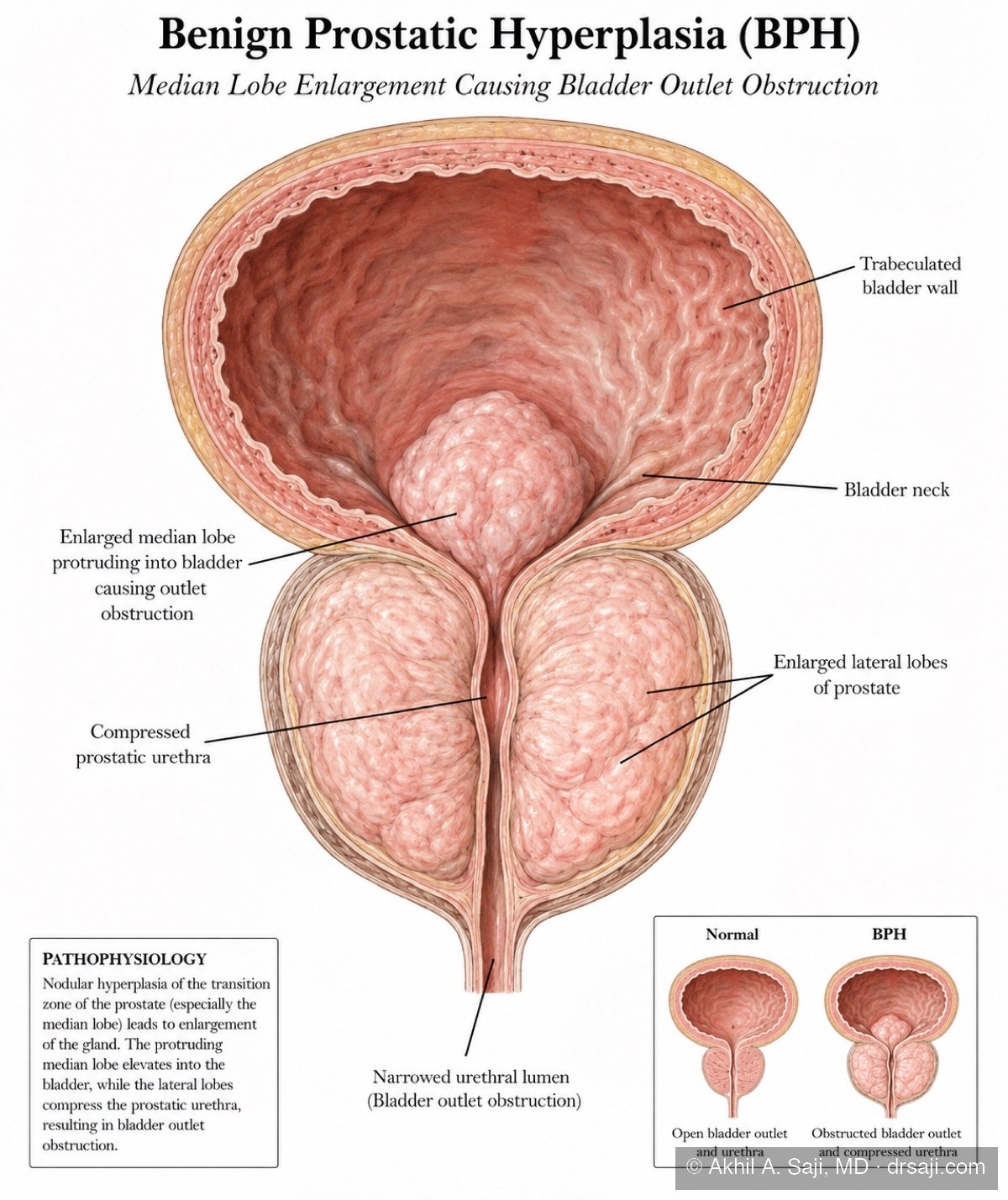
Your bladder responds by working harder. Its wall thickens and becomes irritable — that’s the urgency, the weak stream, the night-time trips, and eventually the incomplete emptying that leads to infections, bladder stones, or complete retention where you cannot urinate at all.
Who is a candidate?
Simple prostatectomy is the right tool when the gland is genuinely large — roughly 80 to 150 mL and beyond, where I decide case by case based on your anatomy. (For reference, a normal prostate is about 25–30 mL.) I most often recommend it for men with:
- A very large prostate with bothersome symptoms despite medication
- A prominent median lobe protruding into the bladder
- Urinary retention — including men currently dependent on a catheter
- Bladder stones or recurrent infections caused by poor emptying
- Bladder diverticula (pouches) from years of straining, which can sometimes be repaired at the same operation
If your gland is smaller than this range, other options — including Aquablation, which I also offer — are usually a better fit. Measuring your prostate accurately (usually with imaging) is one of the first things we’ll do.
The transvesical single-port difference
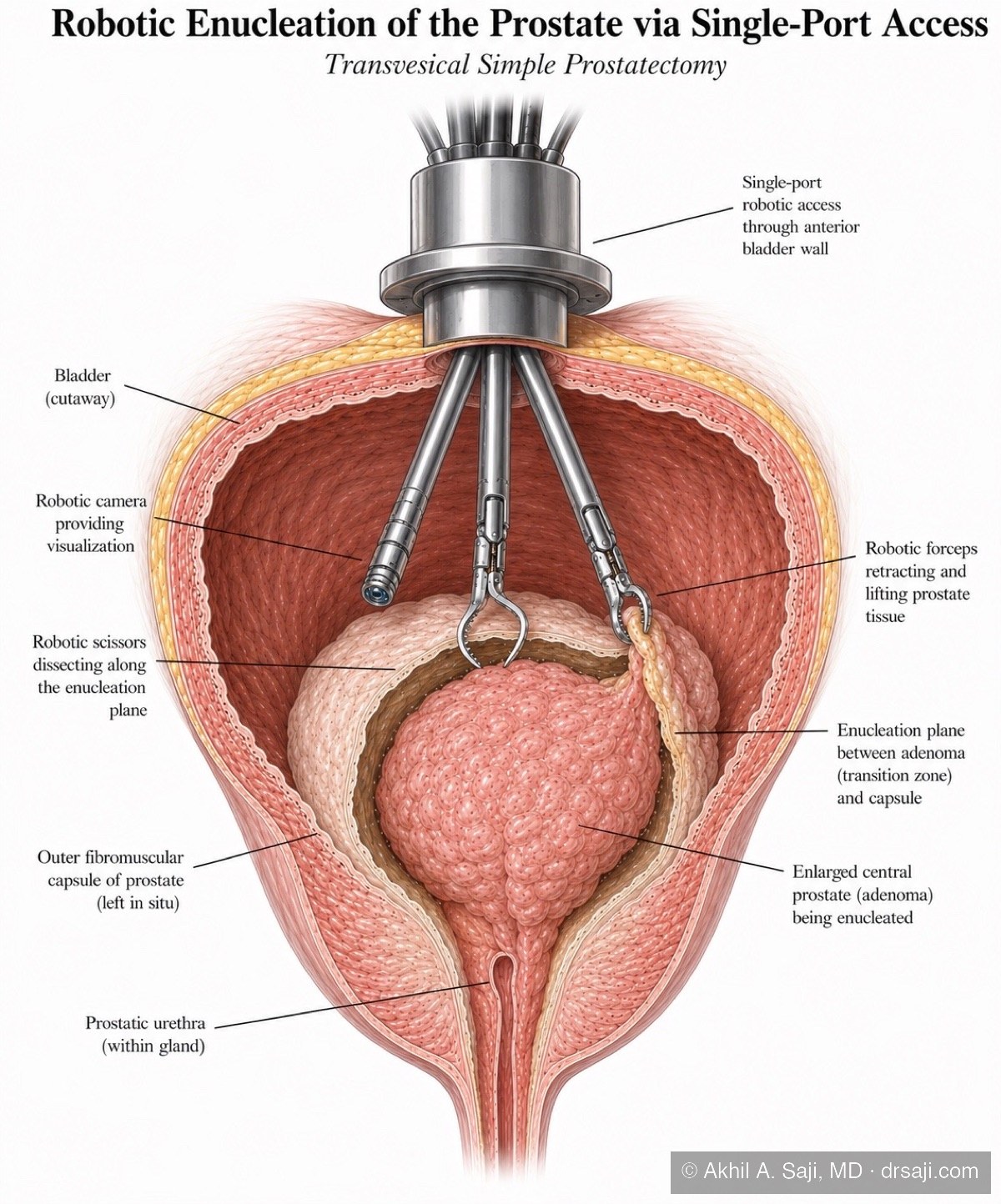
Traditional robotic simple prostatectomy uses five or six incisions across the abdomen and works through the peritoneal cavity — the space containing your intestines. The da Vinci SP system lets me do something fundamentally different: through one small incision below the navel, I dock the robot directly into the bladder and never enter the abdominal cavity at all.
Staying out of the abdomen matters more than it might sound:
- Your bowels are never touched, so they wake up immediately — less nausea, earlier eating, and far less of the bloated “shut down” feeling that follows abdominal surgery.
- Pain is minimal. Most of my patients need little or no opioid medication after discharge; published single-port series report the same.
- Recovery is faster, and going home the same day is realistic for many men.
- Prior abdominal surgery, hernia repairs with mesh, or significant weight are much less of an obstacle, because the entire operation happens in a space those problems don’t reach.
How the operation works, step by step
- Anesthesia and positioning. You’re fully asleep. Unlike multiport robotic surgery, you lie nearly flat — no steep head-down tilt.
- Access. I make a single incision a few centimeters below the navel and enter the bladder directly through its front wall, placing the SP port.
- Enucleation. Working inside the bladder with a magnified 3D view, I peel the enlarged adenoma out of the surrounding capsule along its natural plane — lifting the obstructing tissue away like the fruit out of an orange peel, working precisely around the ureteral openings and the urinary sphincter.
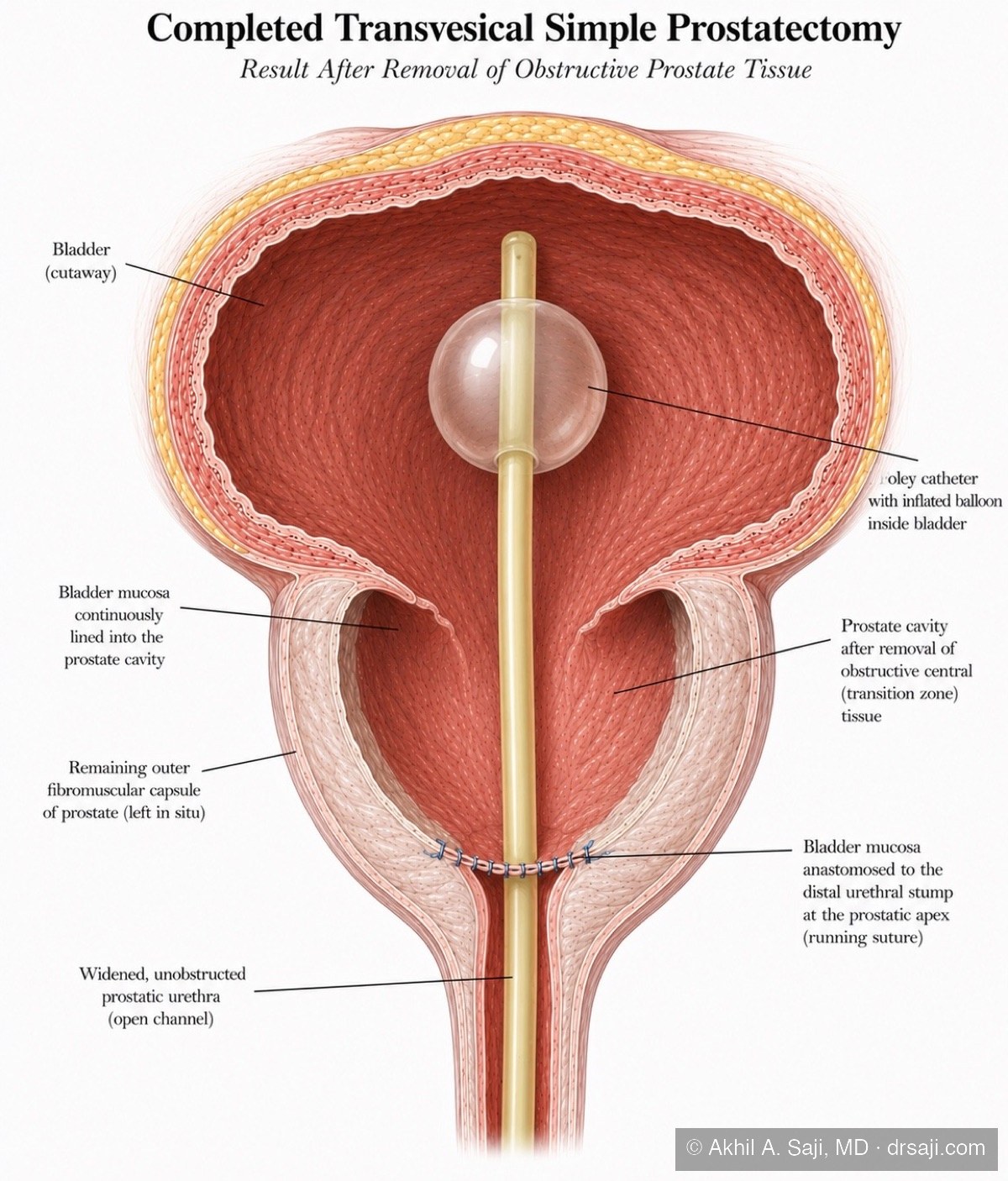
- Reconstruction. This step matters for your recovery: I sew the bladder lining down into the empty prostate cavity and join it to the urethral stump. Lining the raw cavity this way reduces bleeding and irritation while it heals.
- Catheter and closure. A Foley catheter is placed to let everything heal, the bladder and the small incision are closed, and you wake up. The removed tissue is sent to pathology and examined in full.
Your hospital stay
Most of my patients go home the same day or after one night. Because the bowels are untouched, you can typically eat, walk, and manage with minimal pain medication within hours of surgery. Unlike older techniques for large glands, continuous bladder irrigation is usually unnecessary or brief.
The catheter week
You’ll go home with a Foley catheter, which stays in place for about 5 to 7 days while the bladder and the new channel heal. My team will teach you and your family how to manage it before you leave — it’s easier than most men fear. Seeing blood-tinged urine during this week is normal and expected; it clears as the cavity heals. When the catheter comes out in clinic, most men urinate with a stream they haven’t seen in twenty years.
Recovery timeline
- Days 1–7: Home with the catheter. Walking daily, stairs are fine, most men need only over-the-counter pain medication.
- Week 1: Catheter removed in clinic. Expect urgency and frequency at first — your bladder spent years fighting an obstruction and needs time to relearn normal behavior.
- Weeks 2–4: Stream strong; desk work is comfortable; urgency steadily settles. Some intermittent blood in the urine can still appear and is normal.
- Weeks 3–4: Return to full activity, including lifting and exercise.
- Months 1–3: Continued improvement in frequency and night-time urination as the bladder recovers.
What actually improves
This operation treats the blockage definitively, and the published results — including for single-port series — are dramatic and durable: symptom scores typically fall from the “severe” range (IPSS low 20s) to the normal range (single digits), urinary flow rates more than double, and bladders that couldn’t empty begin emptying essentially completely. Men who were catheter-dependent are nearly always freed from the catheter. Because the entire adenoma is removed rather than partially shaved or vaporized, the chance of ever needing a repeat procedure for regrowth is among the lowest of any BPH treatment.
Sexual function after surgery
Two separate things to understand here, and I counsel every patient on both:
- Erections: the nerves responsible for erections run outside the prostate capsule, which is left entirely in place. This operation is not expected to change erectile function.
- Ejaculation: you should expect retrograde ejaculation — semen passes backward into the bladder rather than out, because the internal valve at the bladder neck is altered when the obstructing tissue is removed. It isn’t harmful and doesn’t change the sensation of orgasm for most men, but it does affect fertility. If that matters to your plans, tell me before surgery.
Risks, honestly
Every operation has risks, and you deserve the real list, not a brochure version:
- Bleeding. Large prostates are vascular. Meaningful bleeding requiring transfusion is uncommon with the robotic approach, but not zero.
- Urinary tract infection — treated with antibiotics.
- Temporary urgency and frequency, near-universal early on and occasionally lasting a few months in bladders that were severely obstructed.
- Retrograde ejaculation — expected, as above.
- Stress incontinence (leaking with cough or exercise) is rare after simple prostatectomy — published single-port series report essentially no new cases — because the sphincter is preserved.
- Scar tissue at the bladder neck or urethra causing recurrent slowing — uncommon, and treatable if it occurs.
- Catheter intolerance — annoying but temporary bladder spasms, which medication controls.
How this compares to your other options
- Medications relax or slowly shrink the prostate but rarely control symptoms long-term once the gland is very large.
- TURP — the classic “roto-rooter” — is an excellent operation for average-sized glands but becomes inefficient and higher-risk beyond about 80–100 mL.
- Laser enucleation (HoLEP/ThuLEP) removes the adenoma through the urethra and is a genuinely good option for large glands in experienced hands; the trade-offs between it and robotic simple prostatectomy are worth an individual conversation.
- Aquablation — which I also perform — is a strong choice for small-to-moderately-large glands, but for the very largest prostates, removing the adenoma completely gives the most definitive and durable result.
Bringing multiple tools to this problem means my recommendation is based on your anatomy, not on the one technique I happen to offer.
Frequently asked questions
Is this cancer surgery? No. BPH is benign, and this operation treats blockage, not cancer. All removed tissue is examined by pathology as a safeguard — occasionally that exam finds an unsuspected, usually low-grade cancer, and if so we’ll discuss what, if anything, it means for you.
Do I still need prostate cancer screening afterward? Yes. The outer capsule — where most cancers arise — remains, so PSA checks continue. Your PSA will drop substantially after surgery, which actually makes future screening more sensitive.
Will I be dry afterward, or leak? Leakage is rare after this operation. The urinary sphincter is untouched, and unlike cancer surgery, continence recovery is not a major concern here.
I’ve been living with a catheter. Will this get it out? In nearly all cases, yes — freeing men from chronic catheters is one of the most common and most satisfying reasons I do this operation.
How soon will I notice the difference? Usually the day the catheter comes out. The urgency and night-time waking take longer — weeks to a few months — because the bladder itself needs time to recover from years of obstruction.
Download: Patient handout — Single-Port Transvesical Robotic Simple Prostatectomy (PDF)
Considering this procedure?
I see patients at Swedish in Seattle and care for patients across Washington and the Pacific Northwest. Call to schedule a consultation.
Call (206) 386-6266