Enlarged Prostate (BPH)
Aquablation Therapy for Enlarged Prostate (BPH)
A complete guide to Aquablation — robotic, ultrasound-guided waterjet treatment for BPH that relieves urinary symptoms while preserving sexual function in most men.
If medications for your enlarged prostate have stopped working — or you’d rather not take a daily pill for decades — Aquablation is one of the most compelling surgical options available today, and I perform it at Swedish. It uses a robotically guided jet of water, mapped against a live ultrasound image of your specific anatomy, to remove the obstructing prostate tissue with no incisions and a precision that hand-held instruments can’t match. This page explains how it works, who it’s right for, and what recovery genuinely looks like.
Why an enlarged prostate causes symptoms
The prostate surrounds the urethra — the channel you urinate through — right where it exits the bladder. As the gland enlarges with age, it squeezes that channel and can bulge into the bladder itself. Your bladder compensates by working harder, and that’s what you feel: a weak or interrupted stream, straining to start, urgency, frequent trips at night, and the sense that you’re never quite empty.
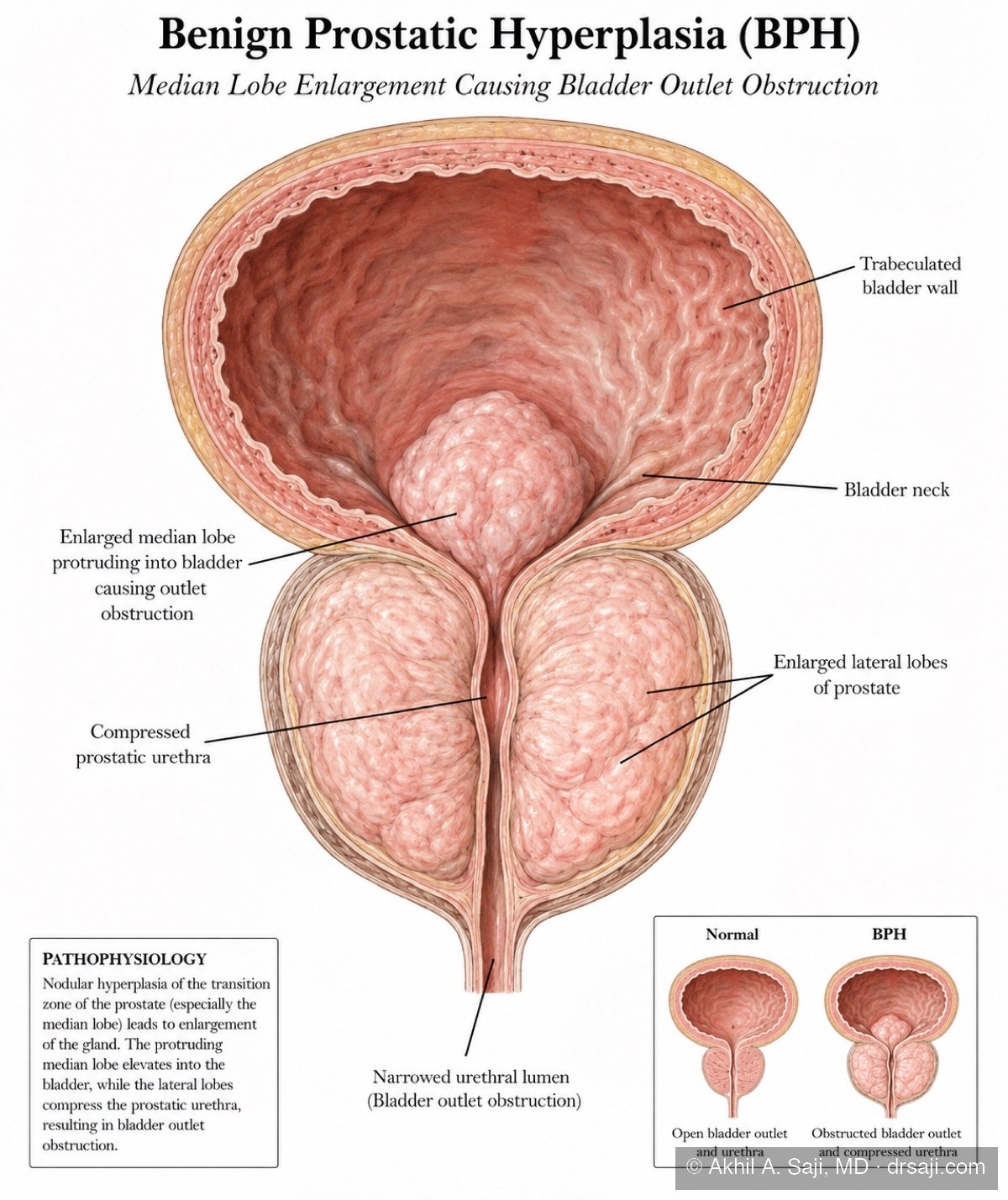
Medications relax or slowly shrink the prostate and help many men for years. But when they stop being enough — or the side effects (dizziness, fatigue, sexual side effects) outweigh the benefit — removing the obstructing tissue is the definitive fix.
What is Aquablation?
Aquablation (the AquaBeam system) removes obstructing prostate tissue with a high-velocity jet of sterile water — no cutting instrument, no incisions through the skin. Everything happens through the natural channel of the urethra.
What genuinely sets it apart is how the treatment is planned. Before any tissue is removed, I image your prostate in real time with ultrasound and map exactly which tissue should be removed and which should be protected — the urinary sphincter that keeps you dry, and the structures near the bladder neck involved in ejaculation. That map is drawn on your actual anatomy, not a textbook average. The robot then executes the ablation exactly as planned, jet angle and depth controlled continuously against the live image, while I supervise closely.
That’s the order of thinking I want you to take away: the precision comes first, and the preservation of function follows from it.
Who is a candidate?
Aquablation works best for prostates of roughly 30 to 100 mL — which covers the large majority of men with symptomatic BPH. Within that range, my recommendation also weighs your anatomy (a prominent median lobe, for example), your priorities, and how much preserving ejaculation matters to you — this is a patient-specific conversation, not a formula.
Outside that range, better tools exist, and I offer those too:
- Very large glands (roughly 80–150 mL and beyond): single-port robotic simple prostatectomy removes the obstructing tissue completely and is the more definitive choice. In the overlap zone around 100–150 mL we’ll decide together.
- Men in urinary retention or with bladder stones from obstruction usually need the more definitive operation as well.
How the procedure works, step by step
- Anesthesia. You’re fully asleep, in the operating room at Swedish. The procedure itself typically takes under an hour.
- Imaging and mapping. I place a small ultrasound probe in the rectum and a camera in the urethra. On the live ultrasound image, I draw the treatment contour — the exact boundaries of tissue to remove, tailored around your sphincter and bladder neck.
- Ablation. The robot sweeps the waterjet through the mapped tissue — the ablation itself takes only a few minutes. The video below shows the console view during this phase: the green contour is the plan, and the jet follows it precisely.
- Hemostasis. After the ablation I inspect the treated cavity and cauterize any visible bleeding points directly — a focused technique I learned from Dr. Mihir Desai at USC. Done this way, no bladder traction is needed afterward, which makes the first night far more comfortable.
- Catheter. A soft catheter is placed and you wake up. The whole treated channel is now dramatically more open.
Your hospital course
Most of my patients go home the same day. If there’s more bleeding than I like, I’ll keep you overnight for monitoring — that’s the exception, not the rule. The catheter stays in for 2 to 3 days while the treated surface begins healing, and it’s removed at a quick office visit (or by yourself at home). Expect pink or blood-tinged urine on and off in the first days to weeks; that’s part of normal healing.
Recovery timeline
- Days 1–3: Home with the catheter. Walking, stairs, and light activity are all fine.
- Day 2–3: Catheter removed in the office. Stream is typically noticeably stronger right away.
- Days 3–5: Most men are comfortable back at desk work.
- Weeks 1–2: Urgency, burning, and frequency settle steadily. Some intermittent blood in the urine is still normal.
- Week 2: Full activity, exercise, and lifting.
- Weeks 2–12: Symptoms continue to improve as the bladder relaxes and the treated area fully heals. (This typically averages 10–12 weeks.)
What actually improves
In randomized trial data and in my experience, Aquablation delivers symptom relief on par with TURP — the historical gold standard — with symptom scores typically falling from the severe range into the normal range and flow rates roughly doubling. Relief is durable: five-year follow-up shows results holding with only a low single-digit percentage of men needing a repeat procedure. The prostate does keep growing slowly for the rest of your life, so no BPH treatment can promise “never again” — but the retreatment numbers here are among the best of any modern option.
Sexual function
This is where Aquablation’s precision pays off most visibly:
- Erections are unaffected. The nerves controlling erection lie outside the prostate and are not in the treatment field.
- Ejaculation is preserved in most men. Because the mapping protects the tissue around the bladder neck and the ejaculatory ducts, most men keep normal, antegrade ejaculation — in contrast to TURP and laser procedures, where retrograde (dry) ejaculation is the expected outcome. I counsel every patient individually; anatomy matters, and preservation can’t be absolutely guaranteed.
Risks, honestly
- Bleeding. The most common significant risk. Some blood in the urine is universal and expected; bleeding that requires monitoring overnight, irrigation, or (uncommonly) transfusion can occur.
- Urinary tract infection — treatable with antibiotics.
- Temporary urgency, frequency, and burning for a few weeks while the treated surface heals.
- Retrograde ejaculation — uncommon compared to TURP, but possible.
- Retreatment — a small chance of needing another procedure years down the line as the prostate continues to grow.
- Rare: injury to the urethra or sphincter, scar tissue narrowing the channel, or persistent incontinence — all unusual.
How Aquablation compares to your other options
- Medications manage symptoms but don’t remove the obstruction, and side effects accumulate.
- TURP resects tissue with an electrified loop, shaving by hand and eye. Excellent symptom relief, but retrograde ejaculation is expected and larger glands take longer under anesthesia.
- Laser procedures (HoLEP, GreenLight) are effective, particularly for larger glands, with the same trade-off on ejaculation.
- Simple prostatectomy — for the very largest glands, removing the adenoma completely beats ablating it.
- Aquablation matches TURP’s symptom relief in head-to-head randomized data while preserving ejaculation in most men, and its robotic execution doesn’t get slower or less precise as glands get bigger within its range.
Because I offer Aquablation, simple prostatectomy, and the rest of the BPH toolkit, my recommendation is driven by your gland and your goals — not by the one instrument on my shelf.
Frequently asked questions
Is Aquablation proven? Is it FDA-cleared? Yes. The AquaBeam system was FDA-cleared in 2017 on the strength of the WATER trial — a randomized, double-blind comparison against TURP, the long-time gold standard. Aquablation matched TURP’s symptom relief with substantially better preservation of ejaculation, and follow-up data now extends past five years. It’s a rigorously studied procedure, not an experimental one.
How long does the procedure take? Typically under an hour in the operating room; the waterjet ablation itself takes only a few minutes. You’ll be at the hospital for a good part of the day between check-in, the procedure, and recovery.
What’s it like having the catheter at home? Easier than most men fear. It’s 2–3 days, you can walk and shower with it, and my team sends you home knowing exactly how to manage it.
When can I drive, work, and fly? Drive: once the catheter is out and you’re comfortable — usually day 3 or 4. Desk work: 3–5 days. Physical work and exercise: about 2 weeks. Short flights are fine within the first week or two; mention longer travel plans and we’ll time things sensibly.
When will my urination actually improve? The stream is usually stronger the day the catheter comes out. Urgency, frequency, and burning take a few weeks to settle, and the full benefit matures over one to three months as your bladder recalibrates.
Can I stop my prostate medications? That’s one of the main goals. Most men stop tamsulosin (Flomax) and similar drugs within a few weeks of surgery, once healing settles. Finasteride/dutasteride usually stops too. Don’t stop anything on your own — we’ll sequence it at your follow-up.
I take a blood thinner. Can I still have Aquablation? Often yes, with planning. Blood thinners raise the bleeding risk, so we coordinate with your cardiologist or prescriber on when to pause and restart around surgery. Tell me everything you take, including aspirin and supplements, at your consultation.
Considering this procedure?
I see patients at Swedish in Seattle and care for patients across Washington and the Pacific Northwest. Call to schedule a consultation.
Call (206) 386-6266